
Location > Nepal > Annapurna
Overview
If you love walking - and we know that feeling - this will be a soul-fulfilling 10-day hike through Himalayan woodland under the gaze of majestic mountains without having to worry about the altitude. The highest elevation reached along the trek is a brief stop at 3210m, where people might experience a momentary shortness of breath. The rest of the journey takes explorers past centuries-old villages, cultivated hillsides, and terraced fields.
This trek can easily be extended by 3 days for those who are keen to explore the Annapurna Sanctuary including the Annapurna Base Camp.
Day 1: Arrive in Nepal’s bustling capital of Kathmandu
The vast majority of visitors from around the world fly into Kathmandu, a sprawling city of more than 1.6 million people. As you step out of Tribhuvan International Airport, you will be greeted by your guide or a company representative who will drive you to your hotel. After finalising your itinerary with your guide at the hotel and answering any remaining questions you might have, you are free to go explore the warrens of colourful alleyways and tourist attractions in downtown Kathmandu. Restaurants, bars and shops open till late during peak tourist seasons.
Day 2: Drive from Kathmandu to Tatopani (1110m)
Today, it will be a day-long drive – and a dramatic change of scenery – from the hustle and bustle of Kathmandu to the subtropical forests of Tatopani (1110m/3642ft), a quiet township by the banks of the Kali Gandaki, a river from the north that cuts through the Himalayas to form one of the deepest gorges in the world.
After a satisfying dinner and before retiring for the night, visit a natural hot spring near your hotel for a soak.
Day 3: Trek from Tatopani to Shikha (1935m)
Setting off from Tatopani, trekkers will encounter a steep, 20-minute ascent of stone steps wedged into the hillside of Gharkola. The climb continues for another hour through dense forests, eventually leading to the top of a ridge: Durbindara. The views here are both stunning - and rewarding as trekkers look back down at the progress they have madeand also look ahead, where Ghara sits higher up, and Shikha higher still. Fortunately, the inclined slope gently eases from this point, and trekkers will be able to enjoy the scenic climb with the Dhaulagiri massif to the west of the Annapurnas ever-present in the distant background. Finally, trekkers will emerge into the large village of Shikha (1935m/6348ft). In Shikha, visitors will enjoy the hospitality of homestay hosts and understand a bit more about Nepal’s diverse culture. This chance to interact and connect with the locals on a more personal level is hard to come by, and completely unavailable to trekkers who opt for hotels and lodges built to accommodate the big tourist groups.
Day 4: Trek from Shikha to Ghorepani (2850m)
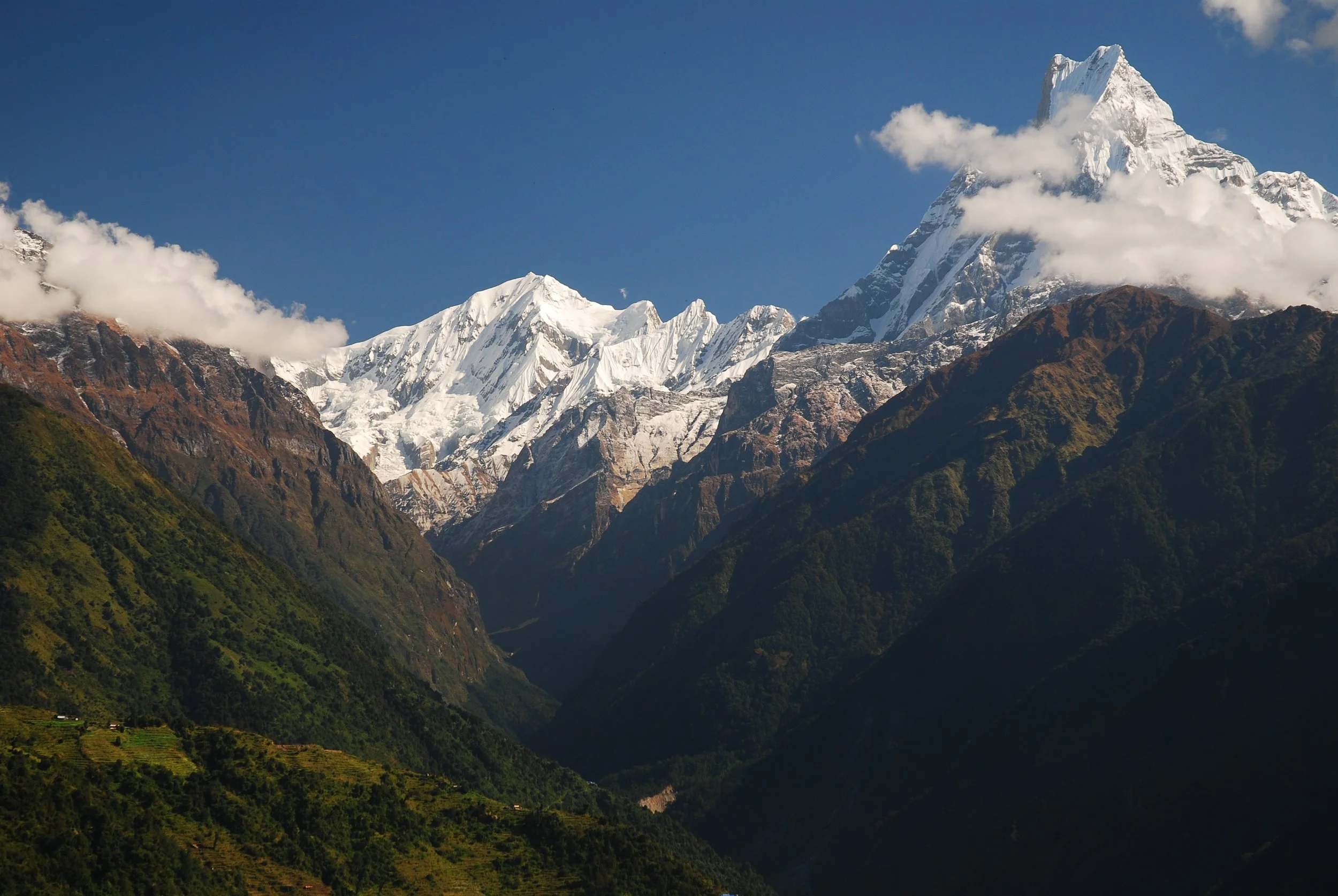
Setting off from Shikha, trekkers will notice as they climb a series of stone steps that many teahouses sit perched on higher elevations, offering glorious morning views of the Dhaulagiri mountain range blanketed in a halo of warm, golden light. Leaving Shikha, the ascent is gentle all the way through Phalate and into Chitre. Then, for the next 3-4 kilometres, it will be a steep climb all the way to Ghorepani (2830m/9285ft), accompanied by nothing but the quiet serenity of lush rhododendron forests and Dhaulagiri peeking through the canopy. Huffing and puffing, trekkers will eventually spot the welcoming gates of “Ghorepani Poon Hill” — one of the busiest villages on the entire circuit due to its world-class scenic views. Should one arrive before sunset, Annapurna South and Machhapuchhere are best viewed at this time.
Day 5: Hike to Poon Hill (summit 3210m) for sunrise view then trek to Tadapani (2630m)
Day 5 will be the longest for trekkers, starting with the 1-hour trek to Poon Hill's summit (3210m/10532ft) in the quiet hours of the early morning. Headlamps are a must! This popular morning summit boasts a spectacular panoramic view of the Dhaulagiri range, Nilgiri and the Annapurna massif. On a clear morning, even Manaslu is visible in the distance. Thus, trekkers will be able to admire three of the 10 highest peaks on earth: Annapurna I (10th-highest), Manaslu (8th) and Dhaulagiri I (7th). After summiting Poon Hill, we begin our long descent to Tadapani (2700m/8858ft). Thankfully mostly downhill, trekkers enjoy a pleasant walk through dense rhododendron and birch forests till Deurali (3050m/10000ft) comes into view, after which the trail drops quite sharply all the way to Banthanti (2650m/8694ft). The final uphill to Tadapani takes roughly 40 minutes, which might feel particularly tough at the end of a long day.
Day 6: Trek from Tadapani to Jhinu Danda (1780m)
Enjoy a slow descent past rhododendron forests and sprawling farmlands, before a steep descent into Jhinu Danda (1780m/5840ft). A short 20-minute walk along the forest lies the Jhinu hot spring.
Day 7: Trek from Jhinu Danda to Landruk village (1565m)
The scenic descent past terraced fields and rushing rivers features a bridge measuring 237m long, a link frequented by people and cattle alike. Upon arrival at the Gurung village of Landruk (1565m/5135ft), the first thing trekkers will notice is the panoramic view of staggering snow-capped peaks, a luxurious sight best enjoyed on a clear day with a cup of tea — as well as the serene company of local homestay hosts.
Day 8: Trek from Landruk to Australian Camp (2060m)
A dradual incline to the popular Australian camp (originally known as Thulo Kharka, meaning “big pasture”) features many ups and downs, but is well worth it for the sight of Annapurna South (7219m), Hiunchuli (6441m) and Macchapuchare (6993m) on the horizon, seemingly only a few kilometres away. Magnificent sunrise view.
Day 9: Trek from Australian Camp to Kande and drive to Kathmandu
The final leg of the trek on foot in the beautiful Pokhara region, then the drive back to Kathmandu.
Day 10: Goodbye – for now
Bid farewell to your guide or even travel mates as you are being driven to the airport for your departure from Nepal. We look forward to your return some day!
START/END Kathmandu
LODGINGS Hotel/ teahouse
MEALS All inclusive
TRANSPORTATION Private vehicle
BEST SEASON Year round except June to mid-September
TRIP DURATION 10 days
TREK GRADING Moderate
TOP ELEVATION 3210m/10532ft
How Big is Your Trekking Party?
Just myself……….$1,750
Two people……….$1,150 each
Three people……$1,079 each
Four people………$970 each
For larger groups, just ask us!
TRIP INCLUDES
Pick up from airport on day of arrival
Hotel stay in Kathmandu for 2 nights
Private vehicle from Kathmandu to trek start point and back
All meals (breakfast/lunch/dinner) en route and during trek, and 3 hot beverages each day of your choice
Stay at teahouses during trek
English-speaking and government-trained guide
Porters to carry your luggage (ratio of 1 porter to 2 guests)
All necessary paperwork, trekking permits and local taxes
TRIP EXCLUDES
Meals in Kathmandu (except breakfast at hotel)
Visa fees and cost of international travel to and from Kathmandu
Personal expenses
Travel insurance, including coverage for outdoor activities up to 5,000 metres, search-and-rescue in mountainous areas, and costs of helicopter evacuation
Tips for guide, porter(s) and driver(s)