
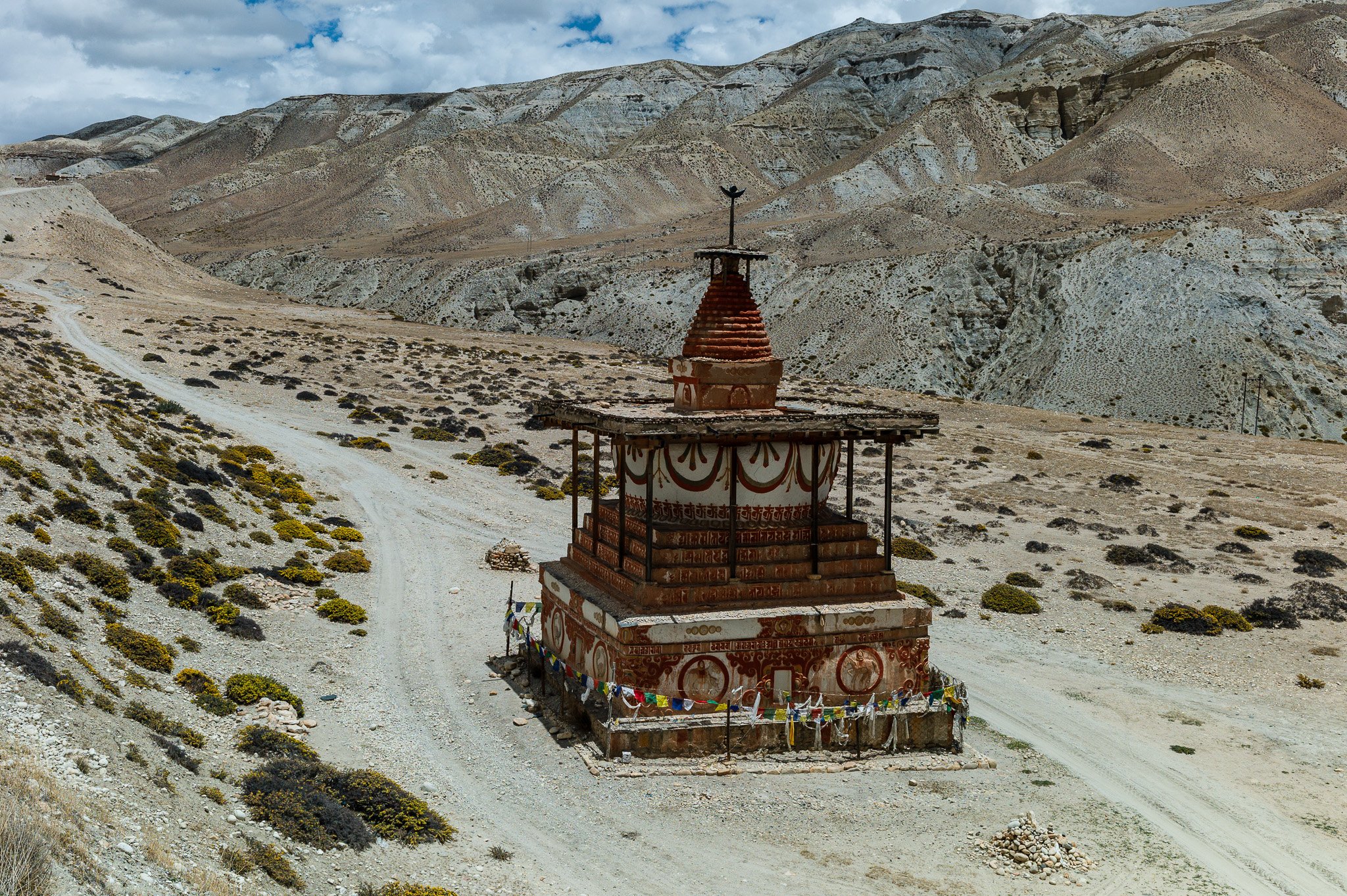
Location > Nepal > Mustang
Overview
Atop a wild, windswept plateau near Tibet, Mustang is one of the last frontiers for tourists visiting Nepal.
Mustang only opened its doors to foreign visitors in 1992. That was almost four decades after Nepal joined the United Nations and removed a ban on tourists. Even so, a special permit is required to set foot in Mustang today.
Ruled by a king until 2008, Mustang had fiercely guarded its Tibetan-influenced culture from outside interference.
Founded by a Tibetan warrior-prince in the 14th century, the Kingdom of Lo, as Mustang was previously known, had been an important part of a medieval trade network of salt, wool, spices and grain. Buddhism also spread from India to Tibet via Mustang.
As well preserved as its language, traditions and values are Mustang’s mud-brick structures. The wall surrounding Lo Manthang, its capital, still stands today after centuries, protected in the rain shadow of the Himalayas.
Ancient Buddhist shrines, palace intrigues, tales of demons and their violent battles with tantric masters, astonishing canyons of sandstone, shale and limestone - Mustang has what it takes to develop world-class tourism.
In late 2025, Nepal further relaxed restrictions on travel to Mustang, lowering the cost of the special permit needed by foreign tourists to enter the region.
On this carefully put-together tour, you will visit Mustang’s visually most spectacular and important sights in just 9 days, travelling in comfort by jeep and staying in well-furnished lodges.
Day 1: Arrive in Nepal’s bustling capital of Kathmandu
Most visitors from around the world fly into Kathmandu, a sprawling city of more than 1.6 million people. As you step out of Tribhuvan International Airport, you will be greeted by your guide or a company representative who will drive you to your hotel. After finalising your itinerary with your guide at the hotel and answering any remaining questions you might have, you are free to go explore the warrens of colourful alleyways and tourist attractions in downtown Kathmandu. Restaurants, bars and shops open till late during peak tourist seasons.
Day 2: Kathmandu to Tatopani (1110m)
Today’s destination is Tatopani (1110m/3642ft), situated in one of the deepest gorges in the world. Western explorers in the 1950s and 1960s spoke of their arduous walks through steamy jungles from Kathmandu to this quiet township by the banks of the Kali Gandaki river.
Known for its natural hot springs, Tatopani is now reachable by road. Construction of NH48 began in the 2010s. The goal is to build a highway that terminates at Nepal’s border with Tibet, giving 1 million people access to a motorable road and boosting trade between Nepal and China.
Before NH48 was built, travel to Mustang by foot used to take 7 days. The northern section in Upper Mustang just before the border with Tibet remains unpaved.
Day 3: Tatopani to Ghami (3510m)
A dramatic change in scenery awaits you today as we head north and enter Upper Mustang.
As we put more and more distance between us and Tatopani, the Kali Gandaki gorge turns into a broad valley flanked by the peaks of the Annapurna range to the east and the dark, brooding Dhaulagiri massif to the west.
The tree line falls away suddenly as we reach the town of Jomsom (2720m/8923ft), notorious for the howling winds that pass through one of the few gaps in the Himalayan mountain chain. Very courageous travellers fly to Jomsom from Pokhara on tiny planes.
Near the Jomsom air strip is the Mustang Eco Museum, which has fallen into neglect over the years due to a lack of funding and tourists. Of interest is the museum’s collection of archaeological finds, including human remains of ancient settlements in Mustang.
From Jomsom, the gateway town of Kagbeni (2810m/9219ft) is less than an hour away by car. The area between Jomsom and Kagbeni is known as Lower Mustang, historically separate from the Kingdom of Lo, or Upper Mustang.
Kagbeni is also the transit town for visitors to Muktinath, especially Hindu devotees making pilgrimages to a temple dedicated to Lord Vishnu.
Set against the dramatic backdrop of the Annapurna mountains, the pagoda-style temple complex is one of Hinduism’s eight sacred places. The current temple structure dates back to the early 19th century, but the site is believed to have existed for 2000 years. Bathing in the temple’s two holy pools and running under its 108 bull-faced water spouts will wash away one’s sins and liberate one’s soul.
The same site is also revered by Buddhists as an abode of the Buddha of Compassion – Avalokiteśvara, who is known as Chenrezig in Tibetan Buddhism and Guanyin in East Asia.
A small chapel adorned with Buddhist prayer flags houses an “eternal” flame regarded as divine by both Buddhists and Hindus. Hidden under an altar, the blue-coloured flame is caused by a continuous seepage of natural gas from inside the ground.
A brief visit to Muktinath (3760m/12336ft) will help in your acclimatisation as we enter Upper Mustang, where the average elevation of the valley floor itself is already around 3500 metres.
Past Kagbeni, where our special permit for Upper Mustang is inspected and endorsed, we continue to follow the course of the Kali Gandaki, which is now a relatively slow, meandering river in an otherwise bone-dry valley.
Looking back to the south, the Himalayas rise up abruptly from the horizon, like a band of snow giants.
By the late afternoon, we arrive at the village of Ghami (3520m/11549ft), an oasis of green with its fields and crops in a barren landscape of brown and ochre.
Some visitors may start to feel the altitude at this point, so we should take things easy. Fatigue, nausea and a dull headache might be experienced. With rest, those symptoms should go away by the following morning.
If there is any daylight left – depending on the season – consider visiting nearby Dhakmar in the evening, when its jagged cliffs glow a sublime red.
According to folklore, the semi-mythical Indian Buddhist master Padmasambhava vanquished one particularly powerful demon while he was travelling to Tibet via Mustang hundreds of years ago.
As the demon was dismembered by Padmasambhava, its blood spilled onto the cliffs of Dhakmar, turning them red. The intestines of the demon were then flung onto the ground, where a very long wall of mani stones inscribed with the Buddhist mantra ‘O mani padme hum’ (“Hail to the Jewel in the Lotus”) now stands.
Day 4: Ghami to Lo Manthang (3840m)
The day has finally come.
As your jeep reaches the last ridge before Lo Manthang (3840m/12598ft), the valley that you have been following for the past few days opens up like the pages of a lavishly illustrated picture book.
On a small plateau lies the fabled city, with the crimson walls of its monasteries and the white-washed ramparts of the royal palace visible even from this distance. On the horizon, you catch a glimpse of Chhoser, the last sizable settlement before Tibet.
“The city of Lo Manthang has been shaped both by the climate and by the occupations of the land’s inhabitants,” French ethnologist Michel Peissel wrote after a visit in 1964 in “Mustang: A Lost Tibetan Kingdom”, an international bestseller at the time it was published.
“The ground floors are dedicated to herding and commerce; there the goods of passing caravans are kept, alongside the animals. The second floors are all closed except for small, narrow windows; here the people live in winter. During the warmer seasons everyone lives on the roof, where the wheat is beaten and flailed in the wind.”
By today’s standards, Lo Manthang is more like a village than a city - its walls are no longer than a few hundred metres (yards) in length and in width.
Its population still resides within those high walls, in houses made of mud bricks as described by Peissel six decades ago. Cattle are still shooed into their pens on the ground floor. Roofs are still decked with firewood and Buddhist prayer flags, co-existing with modern inventions such as satellite dishes and solar panels.
Spend the afternoon exploring the narrow alleyways of Lo Manthang. Try getting onto a rooftop for a more bird’s-eye view.
Not to be missed are the three monasteries within those walls. Admission to all three costs $10.
The most impressive is Thupchen Gompa (“Monastery”) built in the 15th century, with its vividly hand-painted images of buddhas and bodhisattvas peering down at visitors from newly restored murals.
Jampa Gompa, situated directly across from the old royal palace, has an accessible rooftop where the private rooms of the king could be seen. Chode Gompa is the current residence of monks and high lamas.
Those mesmerised by the beauty of Tibetan Buddhist art can visit Lowa Art Gallery located near the gate to the palace. The gallery is owned by Tashi Gurung, who helped restore the 500-year-old murals at Thupchen, Jampa and other monasteries in the area.
Most visitors do not have serious symptoms of altitude sickness in Lo Manthang, but vigilance is needed. Avoid exertion, keep hydrated, and rest if you suddenly feel tired.
Day 5: Explore archaeological sites around Lo Manthang
A short distance north of Lo Manthang is Chhoser, where more monasteries can be found, as well as the village of New Samdzong.
Arguably more impressive than the monasteries are the caves carved into sandstone cliffs where centuries-old Buddhist murals and even remains of ancient humans have been uncovered.
At Konchok Ling, murals dating back to the 14th and even 12th century were discovered by an international team of scholars and archaeologists in 2007.
The short drive to Konchok Ling (sometimes spelled as “Konchokling”) is very scenic.
But, first, visitors need to find “the man who has the key”.
To discourage vandals and people with ill intentions, the sinewy path to Konchok Ling is guarded by a doorway built into a sheer cliff. Only one man in the village of New Samdzong holds the key.
Past the doorway, ascend a long flight of steps carved into the side of a ridge. At the top, before proceeding further, look south for a rare and jaw-dropping view of the Himalayas. The Kali Gandaki gorge is the obvious gap between the Annapurna and Dhaulagiri ranges.
The trail continues on an airy trail on the ridge. Walking sticks and poles are recommended for those doubtful about their footing.
The cave is small - more like a shallow hollow dug into the side of a cliff. Until recently before a staircase and bridge of wooden planks were constructed, visitors had to belay themselves down to the cave by rope.
A partial cave collapse had destroyed some of the murals, with many of the 84 siddhas (“tantric masters”) lost forever as a result. The remaining murals had been mostly damaged by vandalism and the elements. A glass panel now protects the murals.
Despite the pockmarked walls and faded colours, the murals are still a vision to behold, exerting a power that is hard to describe.
Head back to your jeep and drive back to New Samdzong.
Have some sweet tea at the home of the key master before heading to Chhoser.
Near the Chhoser monasteries is an intriguing cave complex believed to date back more than 2500 years.
Explore the tens of very small and very dim chambers of the cave complex spread out over five storeys. A headlamp would come in handy.
Spend the rest of your day either at the Chhoser monasteries or clamber up to the many hilltop ruins of watchtowers on the road back to Lo Manthang.
Day 6: Drive from Lo Manthang to Chhusang via Tsarang (3040m)
Take one final look at Lo Manthang as our jeep climbs to the ridge from which you descended two days ago.
On the way to Tsarang, previously the second-largest city in the Kingdom of Lo, you may encounter determined hikers on the dusty road and contemplative Indian pilgrims dressed in the purest white.
Long-distance buses ferrying monks, local residents and hardy tourists occasionally compete for right of way at hairpin bends in the road. You cross paths with a wizened shepherd and his flock of sheep.
Tsarang is not far away from Lo Manthang.
When Peissel visited Tsarang in the spring of 1964, he developed a friendship with the High Lama of its monastery, who was actually the second son of Angun Tenzing Trandul, the king of Lo.
The young Lama Shabtung Rinpoche had taken a vow to three years of solitary meditation in Tsarang as atonement for marrying and forsaking his celibacy. The lama’s wife died shortly after their marriage, but not without first giving birth to a boy.
“The Lama was very fond of his son, who kept him company,” the French ethnologist wrote.
“It was a touching sight to see the straggly-haired monk reciting endless prayers with his little boy fast asleep at his side.”
Later that year, the crown was passed on not to the lama, but to the king’s third son, Jigme Dorje Palbar Bista.
In 2004, Bista, who had no living children, adopted the lama’s son as his heir apparent.
All their royal titles were officially stripped in 2008 when Nepal became a secular republic.
The lama’s son, Jigme Singhi Palbar Bista, now in his late 60s, owns a luxury hotel outside the walls of Lo Manthang. He believes that tourism will save Mustang.
In the present day, young boys in the region still become apprentice monks at the Tsarang monastery.
The monastery is also where you should ask for the “man who holds the key” to Tsarang’s former palace.
But so decrepit has the palace become over the decades that many of its chambers are now unsafe for use, or exploration by visitors.
One wooden ladder leads to a small chapel on the second storey, where a narrow passage connects to several bare rooms, the last of which hangs an assortment of medieval weapons. Or instruments of torture.
In the dimly-lit room, look for what appears to be a blackened human hand.
Your key master gleefully tells you that it was the hand of the palace architect.
His hand was cut off so that he could not build a similar palace in another kingdom. But he and his family were well taken care of afterwards, as a token of the king’s appreciation for his sacrifice.
Leaving behind palace intrigues, we continue our way to our next stop.
Tonight, we stay at Chhusang (3040m/9974ft), a lovely village by the Kali Gandaki river set against rugged sandstone cliffs.
Look out for wildlife that roams the hills and canyons such as the Himalayan blue sheep!
Day 7: Walk from Chhusang to Tangbe before leaving Upper Mustang (822m)
The village of Tangbe is just minutes away from Chhusang by car. Some hikers cover the distance in about an hour on dusty roads. But there is another way that connects the two villages.
Ahead of us is a 2-hour walk on the opposite bank of the Kali Gandaki river that involves crossing two swaying suspension bridges and sometimes narrow trails on slopes of sandstone and scree.
Those uncertain about a hike can spend a leisurely morning exploring Chhusang’s apple orchards, monasteries and more sky caves, then catch up by jeep at Tangbe.
A village of mud-brick homes and cultivated fields, Tangbe is a quiet stop before we exit Upper Mustang proper.
Perched close to the edge of cliffs are ancient chortens (stupas) of red and white stripes, guarding the village like silent sentinels from another age.
Soon after Tangbe, we arrive at Kagbeni, which marks the southern border of Upper Mustang.
From Kagbeni to the lakeside city of Pokhara, where we will stay for the night, we descend sharply to an elevation of about 800m (2625ft).
Day 8: Drive from Pokhara to Kathmandu
From Pokhara, we head back to Kathmandu by highway.
We will arrive by the mid-afternoon, leaving you with ample time for any last souvenir shopping or last-minute dashes to take in Kathmandu’s many scenic sights.
Day 9: Goodbye – for now
Bid farewell to your guide or even travel mates as you are being driven to the airport for your departure from Nepal. We look forward to your return some day!
START/END Kathmandu
LODGINGS Hotel/ teahouse
MEALS All inclusive
TRANSPORTATION Private vehicle
BEST SEASON Late March to mid-November
TRIP DURATION 9 days
TOUR GRADING Easy with optional moderate walks
TOP ELEVATION 3840m/12598ft
How Big is Your group?
Just myself……….$2,055
Two people……….$1,458 each
Three people……$1,358 each
Four people………$1,234 each
For larger groups, just ask us!
TRIP INCLUDES
Pick up from airport on day of arrival
Hotel stay in Kathmandu for 2 nights and in Pokhara for 1 night
Private vehicle from Kathmandu to trek start point and back
All meals (breakfast/lunch/dinner) en route and during trek, and 3 hot beverages each day of your choice
Stay at teahouses or homestays during trek
English-speaking and government-trained guide
Porters to carry your luggage (ratio of 1 porter to 2 guests)
All necessary paperwork, trekking permits and local taxes
TRIP EXCLUDES
Meals in Kathmandu and Pokhara (except breakfast at hotel)
Visa fees and cost of international travel to and from Kathmandu
Personal expenses
Travel insurance, including coverage for outdoor activities up to 5,000 metres, search-and-rescue in mountainous areas, and costs of helicopter evacuation
Tips for guide, porter(s) and driver(s)
Admission fees for monasteries and other sights in Upper Mustang