
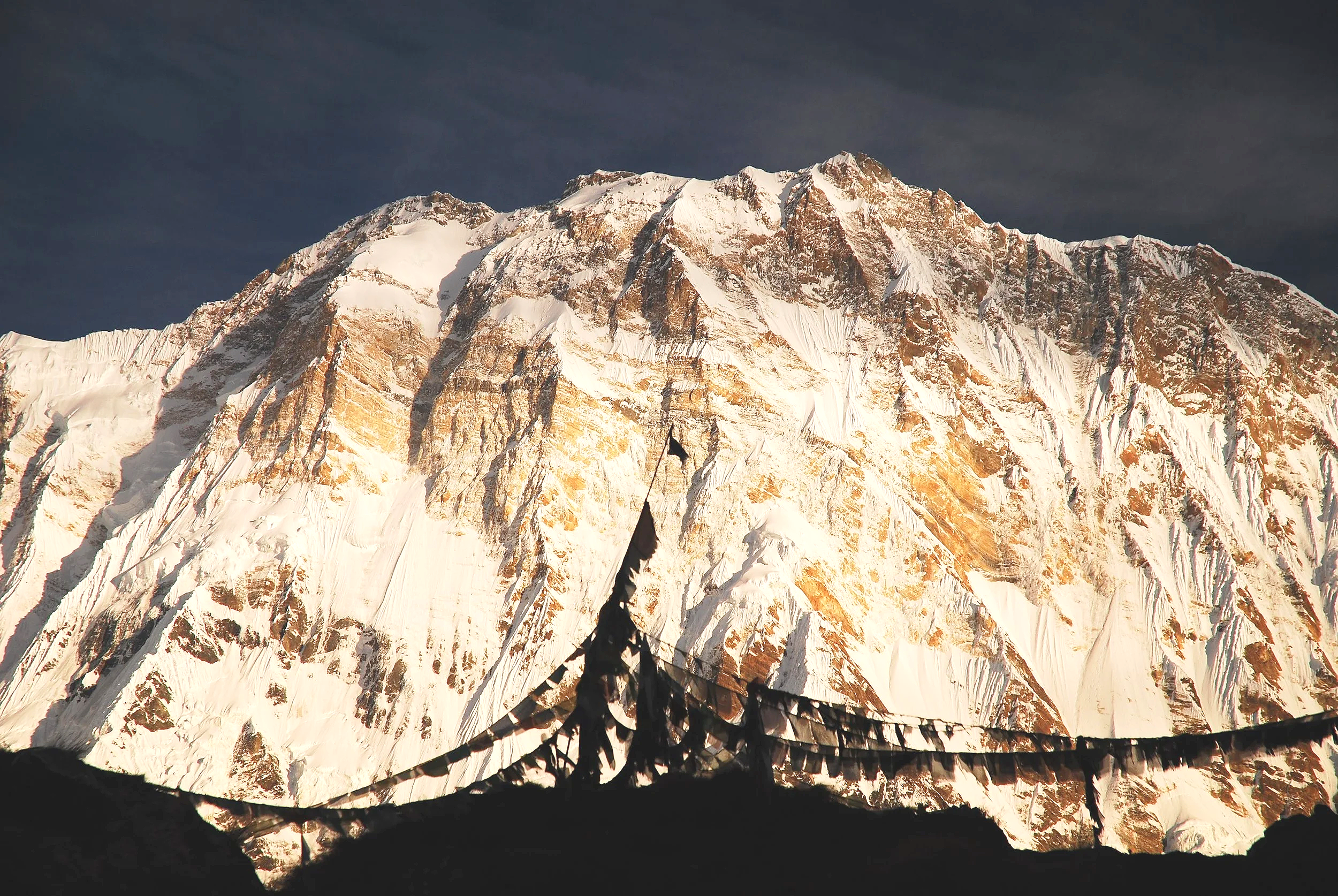
Annapurna
“Resting against the mountain, which was watching over me, I discovered horizons I had never seen”
Maurice Herzog
Named after the Hindu goddess of food and harvest, the Annapurna massif symbolises abundance and nourishment.
The chain of mighty peaks - among them Annapurna I (8,091 metres/26,544 feet) - has enthralled mountaineers for decades.
The range is bordered by two rivers, the Kali Gandaki to the west, known for its canyon which many believe to be the world’s deepest, and the Marsyangdi to the east.
These natural features create striking landscapes ranging from subtropical forests and terraced farmland at lower elevations to barren, Tibet-like high-altitude deserts.
One iconic route through the region is the Annapurna Circuit, one of the most celebrated trekking experiences in the world. It cuts through the Yosemite-like valley of Manang and crosses the famous Thorong La pass (5416m/17769ft). The trail then turns south to the verdant Annapurna foothills, dotted with laid-back villages and forests of bamboo and rhododendron.
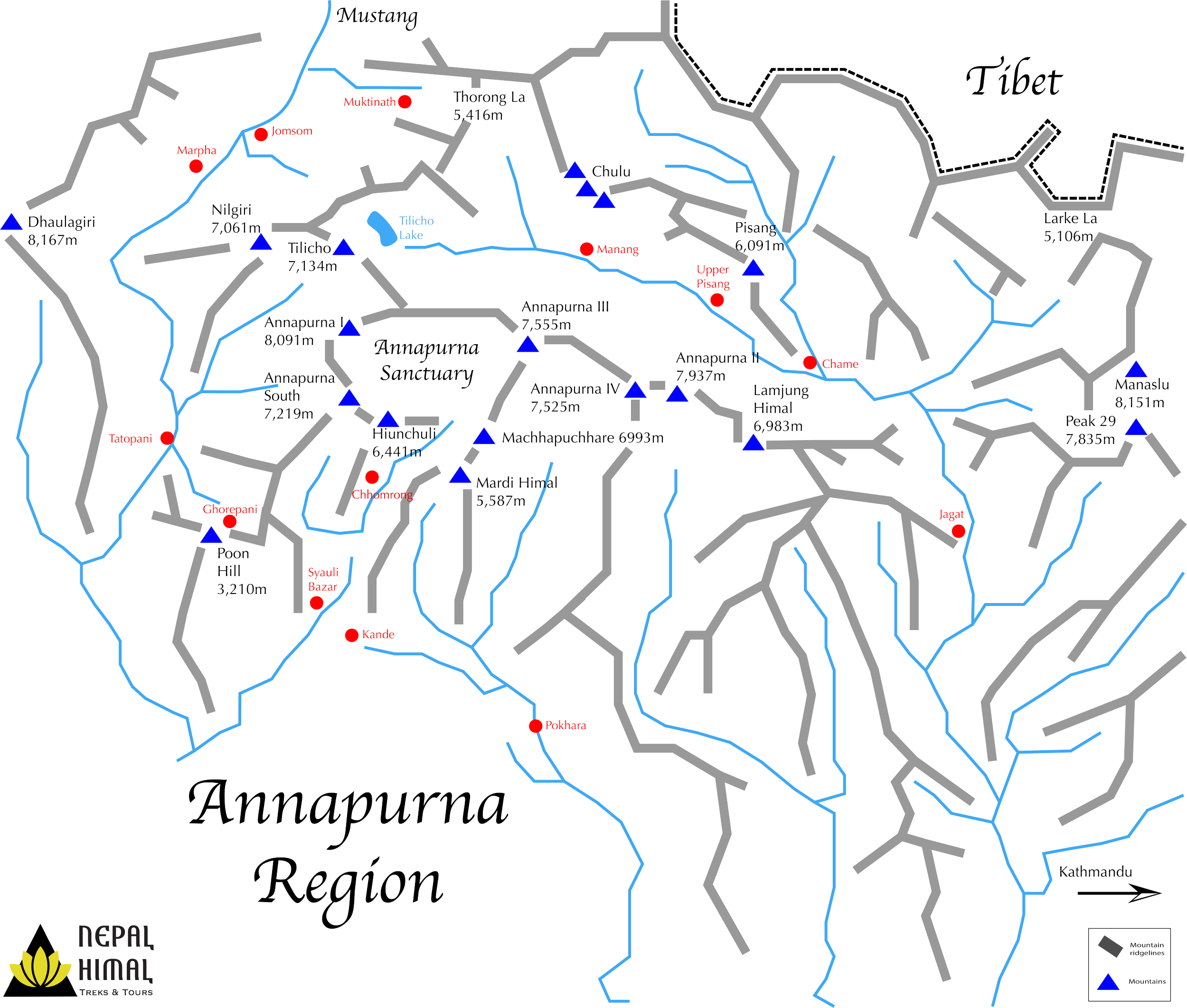
The region can be divided into three parts: Upper Annapurna, following the trail through Manang north of the mountain chain; Lower Annapurna, characterised by lowland forests populated by ethnic groups such as the Gurung, Magar, Thakalis; and finally, the Annapurna Sanctuary, a one-of-a-kind natural amphitheatre encircled by some of the world’s highest peaks.
Trekking in the Annapurna region is not without its challenges, with the altitude and sudden shifts in the mountain weather. Careful planning and an itinerary with a buffer day or two are standard requirements.
Yet, the reward is immense - the chance to visit one of the most stunning landscapes on Earth.
As you explore the trails, cross mountain passes, or simply soak it all in from the patio of a teahouse, you reconnect with the natural world and time distills into small, granular moments, and then without you knowing it at first, seemingly stand still.
The predominant ethnic group in the Annapurna foothills is the Gurungs, a resilient and hardy people of Tibetan origin. Closely related to them are the Magars to the west and the Thakalis to the northwest. The smaller Manangi group resides north of the Annapurna range.
A bit further north lies the little visited valleys of Nar and Phu, populated by a people perhaps older than all those further south.
For explorers, image makers, and casual walkers alike, the Annapurnas beckon with its promise of discovery and self-discovery.
Time slows to gradual ripples across a coffee mug. The stars peer down in their countless numbers. Your woes, unmovable as they have seemed to be, become a memory from a previous life.
Further Reading
“Annapurna: The First Conquest of an 8000-Metre Peak” (1952), Maurice Herzog
“Climbing the Fish’s Tail” (1958), Wilfrid Noyce
“Annapurna Circuit: Himalayan Journey” (1997), Andrew Stevenson
“Annapurna South Face” (2001), Chris Bonington
“Mountains of the Mind: A History of a Fascination” (2003), Robert Macfarlane