
The majority of foreign visitors head for the Himalayan peaks, embarking on multi-day treks in the regions of Everest, Annapurna, Manaslu or remote Mustang. For photographers on these high‑altitude trails, choosing which lenses to bring is a challenge. The goal is to strike the perfect balance: carry a lightweight kit that captures every moment without the burden of heavy or rarely used lenses.
1. What is the Most Versatile Lens Combination for Maximum Coverage?
Photographers often debate whether to pack the full 'holy trinity' of zooms (16-35mm, 24-70mm, and 70-200mm) or to travel light. Nepal demands versatility: you need wide angles for the vast Himalayas, standard focal lengths for street portraits, and telephoto reach to compress distant peaks. If you must compromise and bring just one lens, the 24-70mm is your best bet. When paired with a high-megapixel camera (40MP or higher), it offers enough resolution to crop significantly, mimicking the reach of a longer lens.
2. How Much Weight Can I Realistically Carry at High Altitude?
Once you realize you will be trekking for days above 3,000m (9,800ft), weight considerations become paramount. At these altitudes, a heavy pack does more than just tire you out; the resulting exhaustion can actually increase the risk of Acute Mountain Sickness (AMS). It is often unwise to carry multiple cameras and lenses for this reason, and especially so if you are crossing a high mountain pass like Thorong La, Larkya La or Kang La. Instead, if you are limiting yourself to one body, a versatile 24-70mm paired with a 90mm or 135mm prime offers an excellent balance of reach and portability.
3. Do I Need Ultra-Fast Apertures for Low-Light Cultural Photography?
The question of maximum aperture (f/1.4, f/1.8, f/2.8) directly relates to Nepal's rich cultural photography opportunities in challenging lighting conditions. Ancient temples, monastery interiors, pre-dawn prayer ceremonies, and evening festivals often occur in extremely dim environments. This forces a difficult choice: stick to lightweight f/4 zooms for the trek, or carry the extra weight of f/2.8 glass (or fast primes) to handle the low light. A great compromise is to carry a standard f/4 zoom for daylight, paired with a fast 35mm or 50mm f/1.4 prime for those dim, intimate moments. However, depending on the camera system that you use, your prime lens may either be a lightweight or bulky addition. A lightweight 35mm or 50mm prime is also good for street photography in Kathmandu.
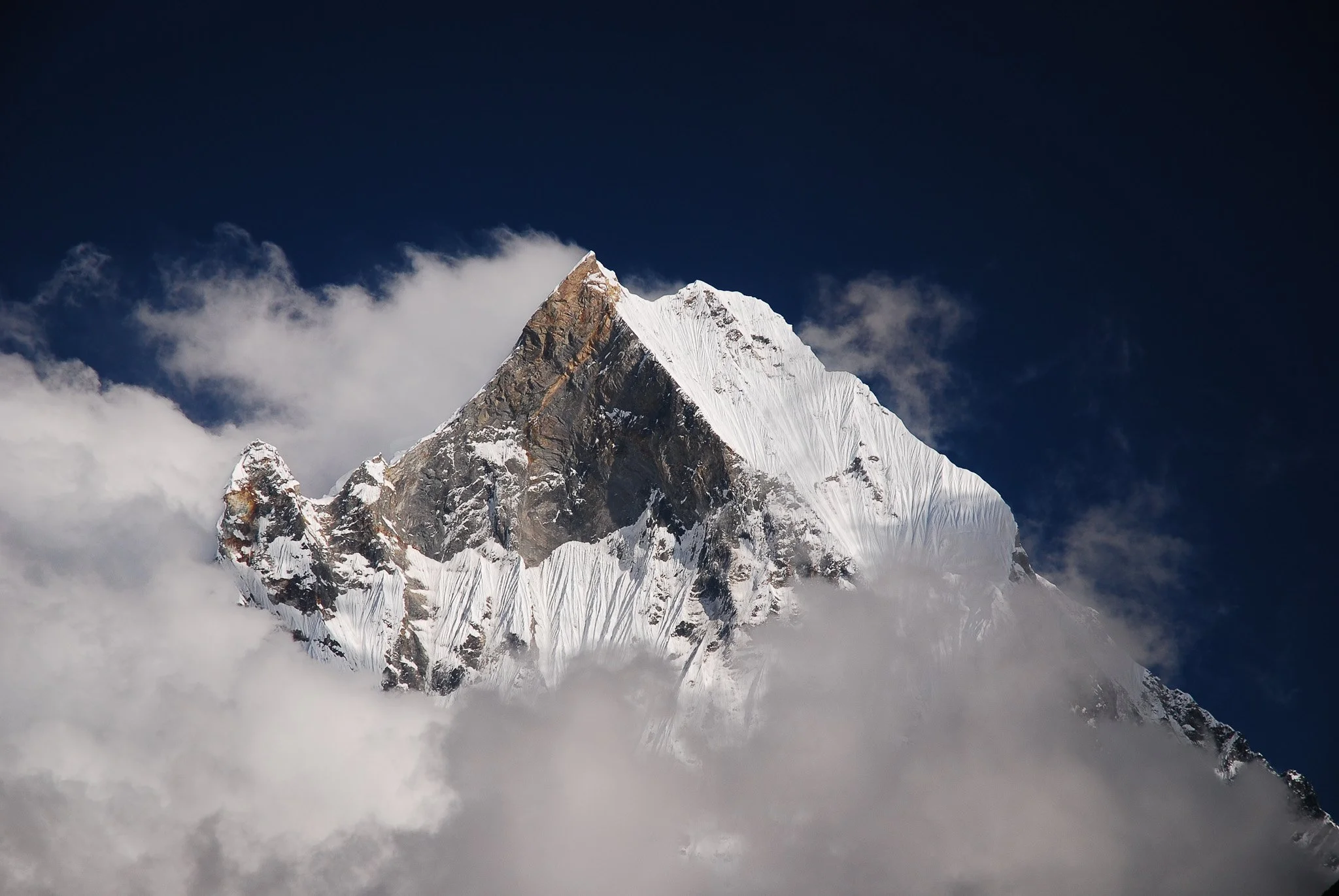
Top: Hiking towards the village of Manang on the Annapurna Circuit Trek (24mm lens); Left: Crossing the Kang La pass from Nar Phu (35mm lens); Right: A view of Machhapuchhare, the ‘fish-tailed’ mountain, on the trail to Annapurna Base Camp (70mm lens)
4. What Ultra-Wide Capabilities Are Essential for Himalayan Landscapes?
Nepal's mountain landscapes are immense, prompting critical questions about ultra-wide lens selection. Photographers must decide whether a 16-35mm zoom is sufficient or if an even wider lens, like a 14-24mm, is necessary to truly capture the overwhelming grandeur of these peaks. This decision also applies to architectural photography in cities like Kathmandu, where narrow streets and confined spaces demand wide angles to capture entire temple complexes. If you're aiming for a minimal kit, your 24-70mm zoom can cover some of these needs, but for true ultra-wide impact, consider pairing it with a dedicated 16mm prime or an even wider option.
5. How Critical Is Telephoto Reach for Mountain Photography and Wildlife?
Long focal lengths are indispensable in Nepal, allowing you to compress mountain layers for dramatic depth, isolate distant villages or monasteries, and capture details of climbing expeditions or wildlife like blue sheep from a respectful distance. The primary question then becomes whether a 70-200mm zoom offers sufficient reach, or if a longer lens like a 100-400mm is necessary for wildlife in Chitwan National Park or extremely distant mountain subjects. For most photographers, a zoom up to 200mm or a dedicated 135mm prime will prove entirely adequate.
Left: Ribung monastery with Manaslu in the background (135mm lens); Top right: A woman weaving outside her home in the region of Nar Phu (24 mm lens); Bottom right: View of the Annapurna mountain chain on the road north to Lo Manthang in Mustang (90mm lens)
6. What Weather Sealing and Durability Standards are Required?
Nepal's challenging environmental conditions—from monsoon moisture to Himalayan snow, and especially the pervasive dust in lower regions—make weather sealing a critical consideration. Professional photographers must evaluate whether their lens choices can withstand sudden weather changes, high humidity, and freezing temperatures. Dust is a real concern on unpaved roads, above the tree line on the higher sections of treks such as the Annapurna Circuit, or in the barren canyons of Upper Mustang. The concern about dust often drives photographers toward higher-end, professionally-sealed lenses. Photographers can also carry two camera bodies to eliminate the need to swap lenses, especially if they are touring Nepal by jeep and not on foot. Carrying two cameras provides a crucial backup in case one fails.
7. What Filters are Essential for the Nepali Light and Landscapes?
Don't overlook the power of filters in Nepal's varied conditions. Start with a UV filter – it's a non-negotiable layer of protection against dust and scratches. Next, a Circular Polarizer (CP) will become your best friend for making skies pop, removing haze, and taming reflections on water and leaves. In the often-intense high-altitude light, a regular Neutral Density (ND) filter is frequently required to achieve desired shutter speeds or wide apertures for subject isolation. For balancing extreme dynamic range in landscapes, a Graduated ND filter will be essential for managing bright skies or snowy peaks against darker foregrounds.
8. Is a Tripod Essential?
Absolutely. Just think of all the photographic scenes you would miss in the early morning, evening, or other dim environments.
Recommended Lens Combinations (35mm equivalent)
Budget-Conscious:
Any kit zoom lens
All-Encompassing Coverage (Zoom-focused):
16-35mm + 24-70mm + 70-200mm
Balanced Approach:
24-70mm zoom (f/2.8) + 135 mm prime
Lightweight (Prime-focused):
35mm + 75 or 80 or 85mm + 135mm
Super lightweight:
50mm f2 (Leica Summicron-M)