
Overview
You have done your Everest Base Camp Trek. You feel ready to tackle your first crossing of a high mountain pass in Nepal.
You have done some research on treks supported by teahouses and lodges that require no camping.
You find three high passes in central Nepal all within a short distance of each other – the iconic Thorong La pass in the Annapurna Circuit, the Kang La pass in the Nar Phu region (an offshoot of the Annapurna region), and the Larkya La pass (also known as Larke La) in the Manaslu Circuit.
But which one suits novice hikers, and which are more for experienced Himalayan trekkers?
Let’s assess their suitability for novice trekkers. Let’s define a ‘novice’ here as someone with limited high-altitude experience but who is moderately fit (capable of walking for 5-6 hours a day on undulating terrain at lower elevations).
All three are high passes (over 5000m/16400ft), involving risks like altitude sickness, steep terrain and variable weather. None is truly beginner-level. Their locations vary in terms of remoteness (distance from the nearest village or proximity of other hikers).
That said, these are all challenging but achievable with the right support:
Thorong La pass (5416m/17769ft): The highest point of the classic Annapurna Circuit trek (11 days). It's a popular route crossing the Annapurna massif.
Kang La pass in Nar Phu (5320m/17454ft): Part of the Nar Phu Valley trek (13 days). This restricted area features Tibetan-influenced villages and connects to the Manang Valley on the Annapurna Circuit. It's less visited but accessible.
Larkya Pass (5106m/16752ft): The climax of the Manaslu Circuit trek (15 days). It circles Manaslu in a restricted zone with stunning, wild scenery.
Most Suitable for Novice Trekkers: Thorong La pass
Among the three, the Thorong La pass remains the most suitable for novices.
Accessibility and Infrastructure: The Annapurna Circuit has excellent trail infrastructure, with frequent teahouses, lodges and eateries. You can trek teahouse-to-teahouse without carrying tents or much food, which simplifies things for beginners. Roads and jeep access in lower sections make it easier to start or exit if needed.
Popularity and Support Network: It's Nepal's most trekked high pass, attracting thousands annually. This means guides, porters and fellow hikers for camaraderie and quick help in emergencies. Group treks are easy to organise due to the popularity of the Annapurna Circuit and the stupendous scenery along the way.
Gradual Acclimatisation and Manageable Difficulty: The itinerary includes built-in rest days (e.g., in Manang at 3540m/11614ft) for altitude adjustment. The pass crossing is demanding (a long day with steep ascent/descent), but trails are well-marked and non-technical (no climbing gear needed).
Seasonal Factors: It’s optimal in spring (March–May) or autumn (late September–November) with stable weather and clear paths. The trails may be crowded, but your fellow hikers provide a safety buffer.
Overall Vibe: Many novices complete it as their intro to Himalayan trekking, often combining it with easier side trips. It's rewarding with diverse scenery (forests, villages, mountains), although acute mountain sickness (AMS) risks are real - monitor symptoms and consider preventive medications like acetazolamide (Diamox).
Potential downsides include the intensity of the pass day (high winds, possible snow), but it's far more forgiving than the others for beginners.
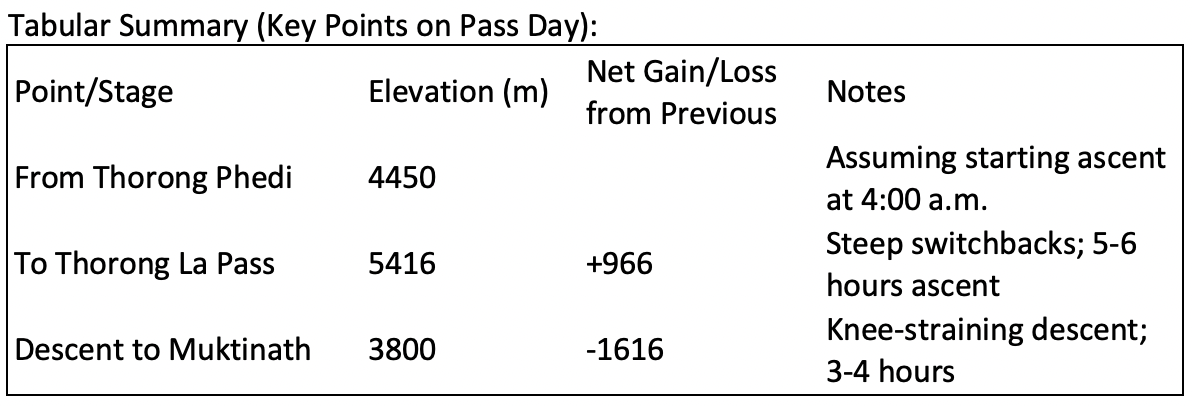
Elevation (m)
5500 | ^ (Thorong La: 5416m)
5000 | / \
4500 | / * \ (High Camp: 4880m)
4000 | /* \ (Thorong Phedi: 4450m)
3500 | / *\ (Muktinath: 3800m)
3000 | / \
| / \
Ascent------------Descent------>
Why Kang La (Nar Phu) Is Moderately Suitable for Novices
Relative Accessibility: As an extension of the Annapurna region, it's easier to reach than more remote areas, and supported by teahouses in villages like Nar.
Difficulty and Support: Trails are steeper and more rugged than Thorong La, with far narrower paths, unstable terrain and less traffic (fewer hikers means less immediate help). The pass involves a tough climb that requires a few days of trekking at lower elevations to acclimatise.
Novice Fit: This is better for those with a bit of hiking under their belt, but doable for fit beginners with a guide. It's less crowded than Thorong La, offering solitude without extreme isolation. If you've done a shorter trek of 3000-4000m (9843-13123ft) like the Mardi Himal trek, this could be a logical next step - many combine it with parts of the Annapurna Circuit for better support.
Drawbacks: There is limited infrastructure in the final stages of the pass day, and weather can turn quickly. It's not as "plug-and-play" as Thorong La, so true novices might be overwhelmed without physical and mental preparation.
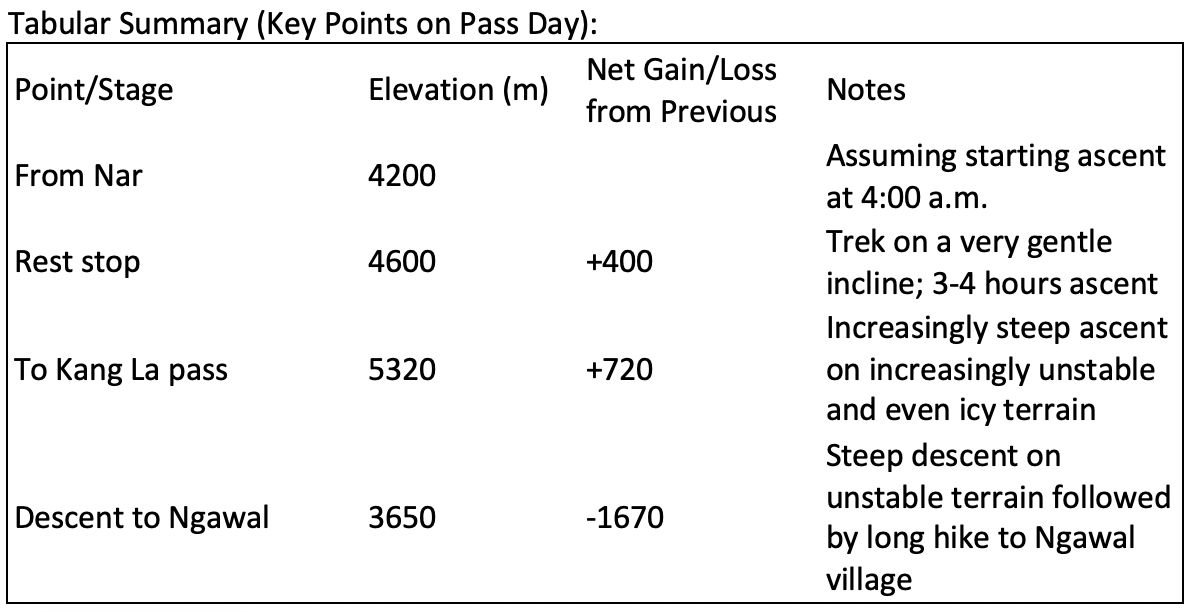
Elevation (m)
5500 | ^ (Kang La: 5320m)
5000 | / \
4500 | / * \ (Rest : 4600m)
4000 | /* \ (Nar: 4200m)
3500 | / *\ (Ngawal: 3650m)
3000 | / \
| / \
Ascent------------Descent------>
Why Larkya Pass Is More Suitable for Intermediates
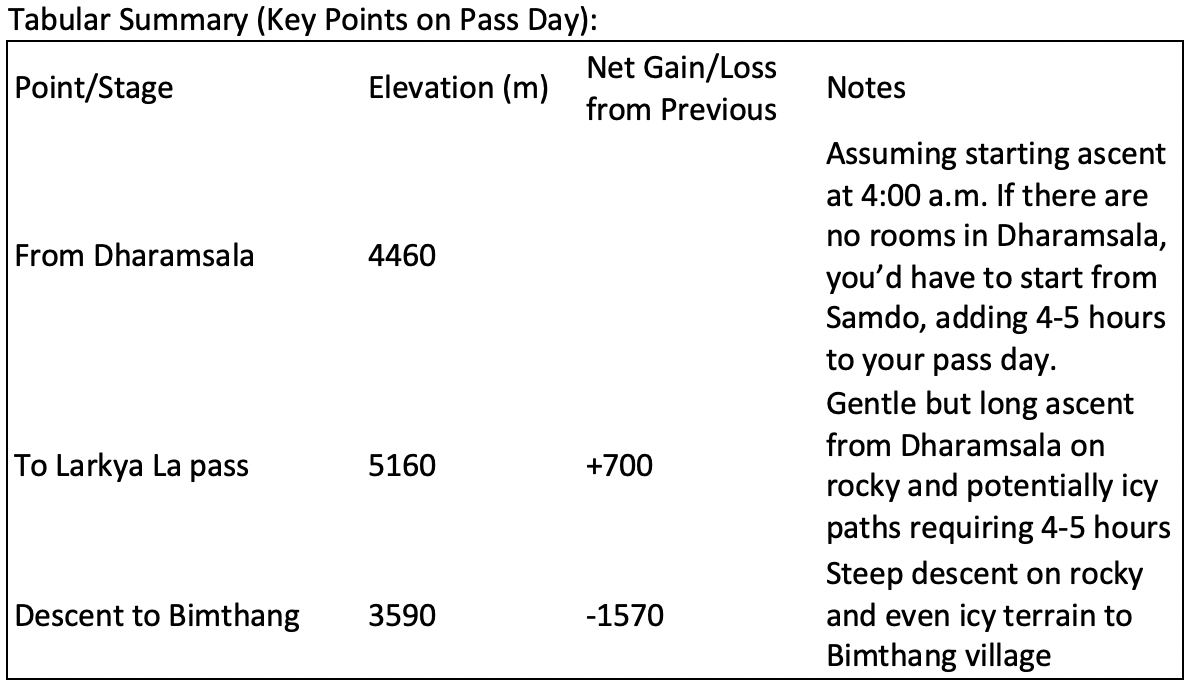
Higher Challenge Level: The Manaslu Circuit is a more challenging trek with a potentially very long pass day requiring strong endurance for 9-16 hours. This depends on the availability of rooms at Dharamsala (see chart below), your fitness level, and how acclimatised you are.
Acclimatisation and Risks: While there are rest opportunities in the middle section of the Manaslu Circuit (e.g., in Shyala, Samagaon, Samdo), the pass day is exposed and weather-dependent, with potential for snow and ice. It's less supported than Annapurna routes - fewer hikers and villages mean emergencies could be harder to manage, and a retreat could also take hours.
Novice Fit: This suits intermediate trekkers who've built confidence elsewhere (e.g., after Thorong La). The raw beauty and fewer crowds are appealing, but the physical and mental demands make it riskier for absolute beginners. It's often described as "Thorong La on steroids."
Drawbacks: The longer duration of the entire trek and the potentially very long pass day can overwhelm absolute beginners. If you're very fit and guided, however, it's possible.
Elevation (m)
5500 | ^ (Larkya La: 5106m)
5000 | / \
4500 | / * \ (Dharamsala: 4460m)
4000 | / \
3500 | / * *\ (Samdo: 3875m ; Bimthang: 3590m)
3000 | / \
| / \
Ascent------------Descent------>
General Advice for Novice Trekkers
Preparation Tips: Build fitness with hill walks, cardio and backpack training. A basic goal would be to be able to walk for 6 hours at a stretch at sea level with 2-3 short 10-minute breaks. Understand acute mountain sickness (AMS) and how to prevent or even treat it. Go with a guide and porter if you are alone, to minimise the risk of failure.
Safety Essentials: Never trek alone - hire a guide/porter. There are unique risks to solo trekkers, which rise exponentially if you are alone.
Easier Alternatives: If these still sound intimidating, consider novice-friendly options like the Mardi Himal trek, the classic Annapurna Base Camp trek, or the Langtang National Park trek.