
Location > Nepal > Everest
Overview
This classic trek to Everest Base Camp near Nepal’s border with Tibet follows the iconic route through the Khumbu Valley, home to the Sherpa people, with stunning views of snow‑capped giants like Everest. The route is well marked and well maintained, with many established, well‑stocked teahouses and lodges along the way, making this trek a wonderful introduction to hiking in the Himalayas. It caters to people of all ages — from 17 to 70. Endurance — the ability to walk at least five hours a day with a light daypack at a consistent pace — matters more than cardiovascular fitness. Acclimatisation is also key, as the trek reaches 5545m (18192ft) at Kala Patthar, a “hill” with dramatic views of Everest, Lhotse and Nuptse. Everest Base Camp, a makeshift village of multi‑coloured tents during the peak climbing seasons in spring and autumn, lies at 5,364 m (17,598 ft) on the Khumbu Glacier, which originates from the Western Cwm at the foot of Everest and Lhotse.
Day 1: Arrive in Nepal’s bustling capital of Kathmandu
The vast majority of visitors from around the world fly into Kathmandu, a sprawling city of more than 1.6 million people in the Himalayan foothills. As you step out of Tribhuvan International Airport, you will be greeted by your guide or a company representative. No trekking today — focus on adjusting to the time zone and resting from any jet lag. You are also free to explore the maze of colourful alleyways and tourist attractions in downtown Kathmandu.
Kathmandu Valley was once ruled by the Malla kings from the 12th to 18th centuries, who built intricate temples like those in Durbar Square. It is said that the valley was a lake until the Bodhisattva of Wisdom, Manjushri, drained it with his sword, leaving behind a fertile and habitable valley. In the 1950s, it served as the launchpad for Edmund Hillary and Tenzing Norgay's historic 1953 Everest ascent.
Day 2: Fly to Lukla, Trek to Phakding (2610m)
After a restful sleep, wake up early for your early morning flight from Kathmandu to Lukla's Tenzing–Hillary Airport, a short but thrilling 30-minute journey. The tiny airstrip, built in 1964 with funding from Edmund Hillary's Himalayan Trust, was carved from a hillside. Named after the 1953 Everest conquerors, it is famously thrilling (or terrifying, depending on the passenger) due to its short runway ending in a cliff. Flights to Lukla are often delayed due to the weather, so pack a book in your carry-on.
The trek starts at Lukla (2,840 m / 9,318 ft) not far from the airstrip and winds through pine forests by the Dudh Koshi River. After 4–5 hours, you arrive at Phakding, a quiet Sherpa village at an elevation of 2,610 m (8,563 ft).
Day 3: Phakding to Namche (3440m)
Cross suspension bridges over the roaring Dudh Koshi today. The path ascends through rhododendron groves exploding in fuchsia and scarlet (especially in April-May), with glimpses of tawny yaks laden with gear against a backdrop of indigo skies and glistening glaciers.
After lunch, the path climbs uphill to Namche (3440m/11286ft), the Sherpa "capital”. Namche Bazaar, as it is also known, was a historic trading post on the Tibet-Nepal salt route that once buzzed with merchants bartering yak butter and wool. Now it acts as the unofficial gateway to the higher environs of the Everest region, packed with gear shops, bakeries offering fresh pastries, and stunning mountain views.
Day 4: Acclimatisation Day at Namche (3440m)
At 3440m (11286ft), you will start to feel the altitude. Use today as a rest day. Take a short acclimatisation hike to the famous Everest View Hotel about 400m uphill for tea and views of Everest and other Himalayan giants. Visit the Sir Edmund Hillary Visitor Centre, the site of a school first established by the New Zealander in 1961. Spend the rest of the day exploring Namche Bazaar’s many shops for souvenirs. Save the long 6-8 hour side trip to Thame (3820m/12532ft), home to many famous Sherpa climbers and cultural heart of the Everest region, for the return leg of the trek.
Day 5: Namche to Tengboche (3860m)
Today, traverse forest trails lined with vermilion prayer wheels before opening to panoramic vistas and the ivory spire of Ama Dablam, "Mother's Necklace," piercing the sky. Take care not to rush today as you start to acclimatise to the elevation. Arrive at Tengboche (3860m/12664ft) in the afternoon. Close by is the Tengboche Monastery, where Tenzing Norgay sought blessings before his 1953 Everest triumph.
Day 6: Tengboche to Dingboche (4410m)
As the trail crosses the 4000m threshold, the landscape shifts to a stark, high-altitude palette: ochre stone walls of Sherpa farms against the cobalt sky, with the lavender glow of distant Lhotse and the emerald patches of potato fields.
In the afternoon, you reach Dingboche (4410m/14469ft), a farming village with roots in Sherpa migrations from Tibet in the 15th century.
Day 7: Acclimatisation Day at Dingboche (4410m)
Today is the second acclimatisation day on the trek. Use it to explore the area or visit a local monastery under the eternal gaze of Ama Dablam (6812m/22349ft) on the other side of the valley. If you are feeling good, consider a day-long hike to Chukkung (4730m/15518ft), a village to the east of Dingboche surrounded by close-up views of Nuptse, Lhotse and Ama Dablam.
Day 8: Dingboche to Lobuche (4940m)
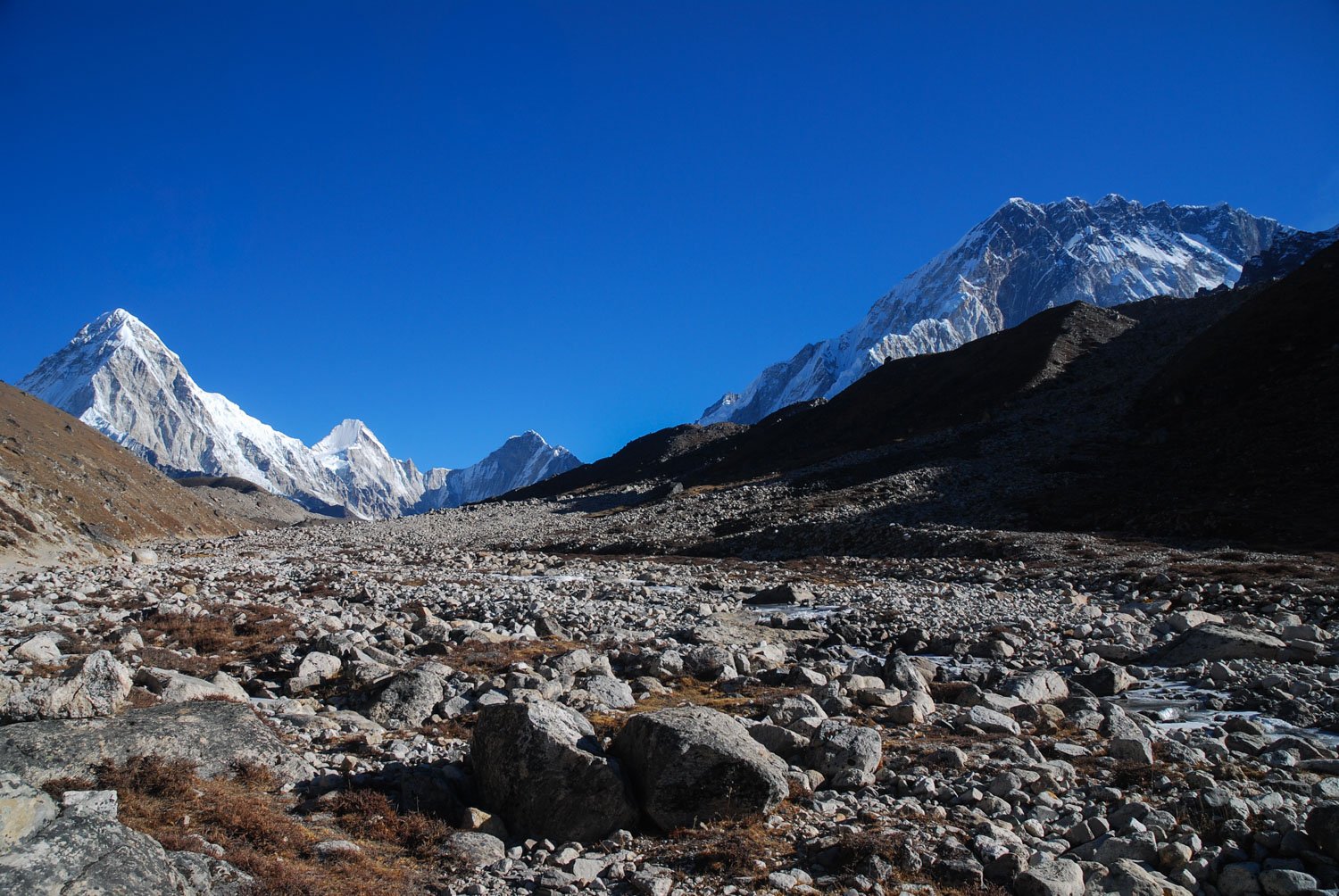
Today is a gradual climb into a lunar-like realm of granite greys and obsidian boulders broken by the turquoise meltwater streams. You will pass stone memorials at Tokla Pass (4830m/15846ft), also written as Thukla Pass, honouring climbers including Scott Fischer and Rob Hall from the tragic 1996 season chronicled in Jon Krakauer's Into Thin Air. The air thins noticeably upon your arrival at Lobuche (4940m/16207ft) - walk slowly and breathe deeply.
Day 9: Lobuche to Gorakshep, Hike to EBC, Back to Gorakshep (5364m)
Today is the BIG day! An early start before dawn is advisable in case the altitude gain slows your progress and prolongs your day. Dress warmly. You should reach Gorakshep (5140m/16864ft) and its basic lodges in 3-4 hours.
From here, the plan is to carry on to Everest Base Camp (EBC) (5343m/17529ft) and return to Gorakshep for the night in about 4-6 hours, then reach the top of Kala Patthar (5550m/18209ft), which is just next to Gorakshep.
However, assess the state of your acclimatisation. Hikers showing severe signs of Acute Mountain Sickness (AMS) at this point should descend immediately back to the last elevation where they felt normal. Even those who return from EBC feeling good might have headaches back at Gorakshep. Fatigue and dull headaches are to be expected. Carrying a pulse oximeter is useful. Anyone with a blood oxygen level of less than 75% should descend immediately.
After lunch at Gorakshep, traverse the Khumbu Glacier's moraine, a chaotic mosaic of steel-blue ice seracs and pebble-strewn paths leading to EBC's flutter of tents. There is no view of Everest’s summit from EBC, which, however, offers the chance to witness the camp life of climbers attempting to climb the world’s highest peak and to socialise with them.
EBC was first established in 1953 for Hillary and Tenzing's historic ascent, where they prepared amid yaks and porters. EBC has since hosted legends like Reinhold Messner, who soloed Everest without oxygen in 1980, proving human limits in the "Death Zone."
Day 10: Hike to Kala Patthar for Sunrise, Descend to Pheriche (4240m)
Wake up before dawn for a 2-hour hike to the Kala Patthar (“Black Rock”) viewpoint where sunrise will bathe Everest in rose-gold light, with the valley below becoming a changing tapestry of amber and inky indigo. The descent to Gorakshep will be quick. The relatively oxygen-rich but windswept village of Pheriche (4240m/13910ft) is 5-6 hours away. You will thank your trekking poles on your descent.
Day 11: Pheriche to Namche (3440m)
Retrace your steps to Namche through Tengboche. After 5-6 hours, you will be back to a familiar teahouse in Namche. Celebrate with a hot shower and bakery treats!
Day 12: Namche to Lukla (2840m)
Today will be a fuss-free 6-7 hour descent back to Lukla.
Day 13: Fly from Lukla to Kathmandu (1400m)
Reserve an early flight from Lukla to Kathmandu to build in some buffer time in case your flight is delayed.
As you board your flight back to Kathmandu, you join the tens of thousands who fly on this route each year. Lukla flights have been a lifeline since the 1960s, but early Everest teams trekked the entire way from Kathmandu - a gruelling 200-km (124-mile) journey.
Day 14: Emergency Day in Kathmandu
This is a built-in buffer day for any delays (e.g., from Lukla flights or extra acclimatisation needs). If all has gone smoothly as planned, utilise it for optional sightseeing tours in or around Kathmandu. Visit Boudhanath or the “Monkey Temple”, spend time recovering at a spa, or explore bustling and colourful local markets.
Day 15: Goodbye – for now!
Bid farewell to your guide or travel mates as you travel to Kathmandu’s airport for your departure from Nepal. We look forward to your return someday!
As you take to the clouds and congratulate yourself on your successful trek, remember Hillary’s words: "It is not the mountain we conquer, but ourselves."
START/END Kathmandu
LODGINGS Hotel/teahouse
MEALS All inclusive
TRANSPORTATION Private vehicle, domestic flights
BEST SEASON March to May and late September to December
TRIP DURATION 15 days
TREK GRADING Moderate
TOP ELEVATION At 5550m/18192ft
How Big is Your Trekking Party?
Just myself……….$2,265
Two people……….$1,850 each
Three people……$1,800 each
Four people………$1,685 each
For larger groups, just ask us!
TRIP INCLUDES
Pick up from airport on day of arrival
Hotel stay in Kathmandu for 3 nights
Private vehicle from Kathmandu to the airport
Domestic flights
All meals (breakfast/lunch/dinner) en route and during trek, and 3 hot beverages each day of your choice
Stay at teahouses during trek
English-speaking and government-trained guide
Porters to carry your luggage (ratio of 1 porter to 2 guests)
All necessary paperwork, trekking permits and local taxes
TRIP EXCLUDES
Meals in Kathmandu (except breakfast at hotel)
Visa fees and cost of international travel to and from Kathmandu
Personal expenses
Travel insurance, including coverage for outdoor activities up to 5,000 metres, search-and-rescue in mountainous areas, and costs of helicopter evacuation
Tips for guide, porter(s) and driver(s)